Showing posts with label Chengdu City. Show all posts

Wednesday, May 16, 2007

Jiuzhaigou– A Place of Water Attraction

Jiuzhaigou literally means nine-village valley - Jiu is for nine, Zhai for village and Gou for valley.

Jiuzhaigou. It’s 450 kilometer north of Chengdu, capital of Sichuan Province, and is famous for its lakes, rivers, waterfalls, mountains and forests.

In this scenic spot, which stretches for 50 kilometers, two valleys join each other to form a Y-shape from west to east. There are nine villages scattered around the valleys, inhabited mainly by the Tibetan nationality.

In ancient times, Jiuzhaigou was called the Green Sea, because of its dense forests. Its relatively low altitude gives it a warm and wet climate for most of the year. This, added to the thawing snow on the mountains, gives it its rich water resources. Mountain springs, ponds and rivers can be seen everywhere in Jiuzhaigou, with the water so clean it’s almost transparent. In fact, visibility through the water can be 20 meters in some places.

Water is part and parcel of Jiuzhaigou’s beauty. As one saying goes: “When you return from Jiuzhaigou, you do not feel the need to go any other place where water is the major attraction.” There’s a certain truth in this.

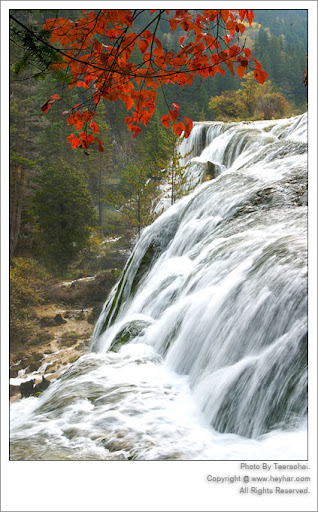
In Jiuzhaigou, you can see still water in lakes as green as jade; slowly flowing water in streams stretching for miles; and rushing water in waterfalls and wide rivers, grand and dangerous. There are also springs with water from snowcapped hills and forests. Everywhere you go in Jiuzhaigou, the sound of water in all its different forms is evident. And you will see “water flowing between trees and trees growing in water”.

Jiuzhaigou was first discovered in the 1970s by a group of lumberjacks. In 1982, it was developed as a scenic spot. In 1987, it was listed at national level as a natural reserve. And in 1992, it became a UNESCO natural world heritage site. Five years later, it secured a place in the Man and Biosphere Network. It’s the only place in China to have been both listed as a World Heritage site and as part of the MAB Network.
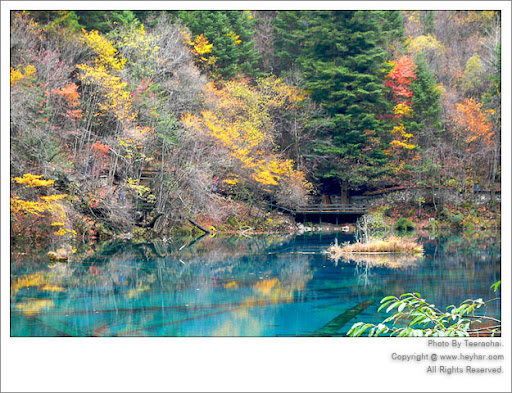
There are ten major scenic spots along Jiuzhaigou. From the entrance to the valley, the lower tip of the Y-shape, we first encounter the Shu Zheng Qun Hai, or a group of lakes among the forest. The lakes are linked to each other, on a mountain slope, with water flowing from the upper one to the lower one. The Reed Lake is the most outstanding. It’s a jade inlay in a cloth of reeds. When the reeds are in blossom, the scenery is spectacular. The flowers wave in the gentle wind, and provide cover for many mallards and bittern in hiding.

The Shuanglonghai, or the Double Dragon Lake, is in the woods. It gets its name from the two dragon-shaped rows of rocks, which can be seen through the lake. If you are lucky enough, you can see dancing swans and large groups of waterfowl.
There are other lakes that the locals call “Hai” in Shu Zheng Qun Hai. All the lakes are like links in a chain and cover a distance of more than five kilometers.
Up from the Shu Zheng Qun Hai is a group of waterfalls. Nuorilong Waterfall, the widest in China, is located there. As you’ll see if you go there, the waterfalls come in many shapes and sizes.

Well, I hope that’s whetted your appetite to go and see Juizhaigou. We’ll have more on this fascinating place again next Time.

More Photo :
Juizhaigou

Chengdu, Sichuan, China

Chengdu : Located in Southwest China, Chengdu is the regional capital of Sichuan province. Covering an area of 12.39 square Km, its east longitude extends from 102°54′to 104°53′and its north latitude extends from 30°05′to 31°26′.The average cultivation index of the city has reached 38.2%. Chengdu enjoys favorable agricultural conditions, and it has long been known as the Storehouse of Heaven. It is the important production base of commercial vegetable oil, vegetables, fruits and Chinese medical herbs.Chengdu has typical sub-tropical humid climate, with an annual temperature of around 17.5°. The annual rainfall of the city is 1,1246mm, with an annual sunshine of 1042-1412 hours. There are several climatic zones in Chengdu, namely, warm temperate zone, temperate zone, frigid-temperate zone, sub-frigid zone and frigid zone, making the city favorable for agricultural production and tourism development.

Chengdu has 12 rivers such as Ming River and Tuo River, together with numerous tributaries. Apart from the reputed Dujiangyan Irrigation System, reservoirs, pools and weirs crisscross in the city, with an effective irrigating area of 366,000 hectares. It is roughly estimated that there are 11 classes, 200 families, 764 genera and 3000 kinds of animals and plants, in which 2682 are main plants and 237 main animals. Precious plants are gingko tree, dove tree, michelia wilsonii and henryi; national protected endangered animals include panda, red panda, golden monkey and gnu. There are more than 860 Chinese medical herbs, in which hemlock parsley, curcumae, Fructus Mume and Rhizoma Coptidis are renowned worldwide.

Chengdu is rich in mineral resources, proven metal minerals include iron, titanium, vanadium,copper, lead, zincum, aluminium, gold, silver, strontium and REE. There are more than 60 Non-ferrous metals, including glaucocerinite, picrolite, gypsum, calcite,limestone, marble, shale, gravel, coal and natural gas.

Chengdu Plain and Ming River valley boast rich water resources. It has favorable climate and abundant resources. People of all nationalities lived and prospered here since ancient time, they gathered, planted, fished, and raised animals, providing necessary precondition to create unique cultural mode and civilization. From the perspective of the main component of culture---people, Ancient Shu State had a large population. More than 10 nationalities such as Han, Tibetan and Qiang lived in Chengdu Plain and Ming River valley ever since time immemorial. They were creator of the culture and in turn enjoyed the culture. They had their own distinctive living customs, religious beliefs, festivals, dressing, celebrations and dancing parties, all of which added various elements into Shu Culture.
More Photo :
Chengdu

Monday, May 14, 2007

Photo Giant Panda From My Trip

Giant panda, as the "National Treasure" of China, is the flag animal of the conservation of animal diversity in the world and ecological environment protection. Besides, giant pandas bring people happiness and joy of returning to Nature with their beauty and characteristics. It is the requirement of thesustainable development of the relationship between human beings and Nature to make giant pandas under careful conservation. What's more it is the wish of all the peoples around the world. However, there are only 1000 pandas existing in this world with their low group reproductive ability and unclear group heredity structure. The surviving environment of the giant pandas is becoming worse and worse due to the degrading of the ecological environment and certain factors of human beings. It has a long way to go in the course of the conservation of giant pandas. The core of conserving giant pandas and other endangered animal species due to human beings, is not only avoiding hurting them but needs the continuous concern and care of people all around the people towards these endangered animals. People worldwide should pay attention and love to these animals and rescue them from the worsening environment.

Chengdu Research Base of Giant Panda Breeding (thereafter referred to as Giant Panda Base) is one of the most successful and important institute in the field of conservation and research of giant pandas. Since 1970s, its former organization (that is the ex- Chengdu Zoo) has been engaged in rescuing giant pandas from wild nature. And all the pandas now in the Giant Panda Base are generated from the 6 rescued giant pandas. Generations of technical researchers paid their sincere attention to the giant pandas in the fields of illness protection and breeding research. Now the pandas in Giant Panda Base have reached 49 and established the largest migration group of 39 pandas. At the same time, it has laid sound foundation in the fields of breeding, scientific research, protection, education, international communication& cooperation, environment construction. Giant Panda Base has been recognized as the Top 500 by the United Nations and now it serves as the leading institute in the conservation of giant pandas. However, conservation of giant panda is supposed to be a public benefit course.Along with the increase of the giant panda groups nd the rapid development of the conservation courses, Chengdu Research Base of Giant Panda Breeding has to be faced with the insufficiency of funds in the aspects of providing food, medicines, conservation and research for the giant pandas. Our efforts have provided hope for the giant pandas future, but it is determined by the society if the giant pandas can survive or not. The care and support from all lines of businesses have provided giant pandas the necessity of survival. If every one of us can show our concern and love towards the giant pandas and other endangered species, it would be realized that the coexistence between human beings and specious animals like giant pandas. The future of human beings will also benefit from this because it offers vitality and hope of greenness to our descendents.


Chengdu Research Base of Giant Panda Breeding, in the pursuit of propagandizing and enhancing the sense of conservation of the society, puts forward the program "Program of Donation for Giant Panda Conservation". Giant Panda Base expects, through this program, to solve the difficulties and problems in the fields of fostering, research, education and environmental construction. This program urgently needs the support and concern from friends all around the world. All the people who are interested in this program are welcomed.

More Photo

... My Photo Adventure ...